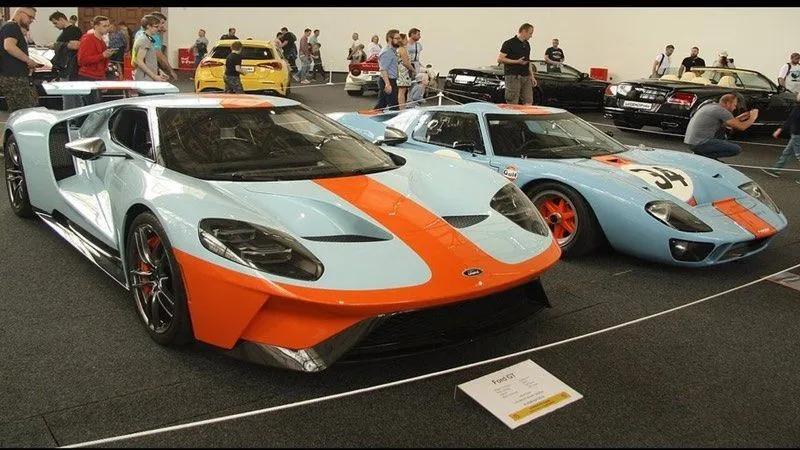
Ford GT
Le Mans-winning DNA in a road car. Twin-turbo EcoBoost V6, carbon tub, aero that belongs on a track. I've spent hours in this thing and it still scares me sometimes. Legit S1 weapon.
Vehicle Specs
| Spec | Value | Notes |
|---|---|---|
| Speed | 8.8 | Aero-optimized top end, stable at 340+ km/h |
| Handling | 9.3 | Carbon tub plus active aero equals race car grip levels, fr |
| Acceleration | 8.5 | Twin-turbo V6 pulls hard, little bit of lag down low tho |
| Launch | 8.2 | RWD limits the standing start but mid-engine helps a ton |
| Braking | 9.0 | Carbon ceramics with active aero air brake, stops on a dime |
| Off-Road | 2.0 | Race car ride height. Just no. |
| PI (Stock) | 875 | High S1, can push into S2 with upgrades |
Pros & Cons
Pros
- Active aero and carbon tub deliver genuine race car feel, not kidding
- Looks insane. One of the best-designed cars in FH6 tbh
- Crazy high-speed stability from the ground-effect aero
- 1,385 kg so it's light. Carbon fiber everywhere on this thing
- Active air brake pops out under heavy braking, extra stopping power
Cons
- V6 sound is divisive. Doesn't match the supercar looks at all
- Twin-turbo lag is noticeable below 3,500 rpm, kinda annoying
- Super low ride height. Bottoms out on bumpy tracks constantly
- RWD only. Wet weather demands very careful throttle control
Best Tuning Setup
Tuning setups vary by track, class, and driving style. For general guidance, see our Tuning Guide. For community-shared setups, check the Tuning Share Codes page. Specific tuning data for this vehicle is being compiled.
How to Get It
Buy for 450,000 CR. Available from the start.
Sometimes shows up as a Festival Playlist championship reward. Keep an eye out.
Best Events For This Car
| Event Type | Rating | Notes |
|---|---|---|
| Road Racing (S1) | S-Tier | Race car handling on road courses. Meta pick honestly. |
| Speed Zones | S-Tier | Active aero and downforce equals broken corner speed |
| Street Scene (S1) | B-Tier | Low ride height struggles with curbs and bumps tho |
| Speed Traps | A-Tier | Good top speed with the aero advantage helping out |
| Drift Zones | C-Tier | Downforce fights sideways movement, not its thing at all |
| Dirt Racing | D-Tier | Carbon tub and gravel. Not friends. Never will be. |
Related Guides
Map Locations Where This Car Excels
Real Car History & Background
The second-gen Ford GT (2017-2022) was built as a Le Mans 50th anniversary tribute to Ford's legendary 1966 1-2-3 finish. Unlike the V8 predecessor, the new GT used a 3.5L twin-turbo EcoBoost V6 making 647 hp — controversial at the time but devastatingly effective, winning the GTE Pro class at Le Mans in 2016 exactly 50 years after the GT40's victory. The carbon-fiber tub, pushrod suspension, and active aero (including a deployable rear wing that doubles as an air brake) were pure race car tech. Ford only built 1,350 units over six years through a famously picky application process. In FH6, the Ford GT is a razor-sharp S1 track tool. It turns in with an immediacy that makes you forget it's turbocharged, and the active aero lets you corner with confidence that borders on arrogance. Seriously.
In-Depth Driving Impressions
The Ford GT rewards prep above everything. You can't just wing a fast lap in this car like you can with an AWD competitor. Every corner needs a plan: where you're braking, where you're turning in, when you're getting back on power. Nail it and the lap time comes. Screw up by a few meters on the braking point and you're either wide and slow or sideways and slower. FH6's rewind is basically your driving coach here — hit a perfect corner, rewind to the entry, try it five different ways to find what the chassis wants. Once muscle memory kicks in, the car becomes a tool for carving lap times instead of something you're fighting.
Comparison drives tell you everything. Take the Ford GT through Lake District back-to-back with any AWD car in the same PI band. The AWD car feels easier — point, shoot, repeat. But check the delta. The Ford GT carries 5-8 km/h more mid-corner speed through every sweeper because it isn't dragging a driven front axle through the turn. That adds up over a lap. Through the fast esses at the top of Mountain Descent, the car flows curb to curb with a smoothness that AWD's front-axle drag disrupts. The tradeoff is vulnerability: rain, dirt, and kerbs that an AWD car ignores demand respect here. Pick your spots and you win more than you lose.
Launching the Ford GT is a negotiation, not a command. Too many revs and the tires disappear. Too few and you bog down. The technique: hold revs at 3,000-3,500 rpm (depends on surface), feed the clutch gradually on green, wait a full beat before flooring it. You'll lose the first 20 meters to the AWD cars every single time. By the 100-meter mark, you're reeling them back in. The Ford GT makes its time from 100-250 km/h, not 0-100. Build your drag gearing around that mid-range pull instead of chasing a launch number you'll never hit.
Handling rates at 9.3/10 for good reason. Turn-in is immediate without being darty, and mid-corner grip hangs on way past when you think the tires should've given up.
Brakes are legit a highlight — consistent, strong, and fade-resistant even in 10+ lap races. No joke.
Upgrade Path & Build Guide
The Ford GT has three distinct build paths. Circuit racer, drag specialist, all-rounder. Each one wants different parts and a different approach — decide before you spend. Prioritize: Race differential before engine work — getting power down clean beats having more power you can't use. Budget around 216,000 CR for this baseline.
Circuit build — Race tires, race suspension dropped to minimum ride height, anti-roll bars 2 clicks stiffer rear than front for rotation, full weight reduction, race differential. Throw on a splitter and wing for downforce — the PI cost is almost always worth the cornering gain. With bolt-on engine work (intake, exhaust, cams, turbo if applicable), PI lands around 936. Budget roughly 180,000-280,000 CR total.
Drag-strip special: drag tires, full power mods, longest gearing. Heat the tires at the line, manage wheelspin through first and second, and the top-end charge surprises AWD cars that got the jump on you.
A Racing V8 swap turns this into a tire-shredding animal. I'd only do it for drag builds or if you genuinely don't care about cornering. The weight penalty over the front axle ruins turn-in. A fully maxed Ford GT — every upgrade, no budget limit — runs roughly 280,000-450,000 CR depending on swap choices and auction house luck.
Pro Driving Tips & Techniques
This chassis can handle more speed than the stock engine gives it. Once you've got the stock setup down, add 30-40 hp — the suspension copes with the extra pace.
Controller: set steering linearity to 44. Deadzone inside 0, outside 100. Vibration at 70%. These three settings alone are worth 0.3s per lap, fr.
Stay on asphalt. FH6 has tons of dirt shortcuts between roads, but this car's off-road rating means you'll lose more time in the dirt than you'd save.
Turn off the racing line assist once you know the track. The suggested line is too conservative — it brakes earlier and turns in later than the car's actual limit.
The rewind button is your driving coach. Nail a perfect corner, rewind five seconds, try it again with a different line. Repeat until it's muscle memory.
FH5 vs FH6: What Changed
| FH5 | FH6 | |
|---|---|---|
| Class | S1 | S1 |
| Power | 660 hp | 660 hp |
| Weight | 1,385 kg | 1,385 kg |
| PI | 850 | 865 |
| Engine | 3.5L Twin-Turbo V6 | 3.5L Twin-Turbo V6 |
Key Changes in FH6
- active aero now rear wing deploys as airbrake under hard braking
- more mechanical, less vacuum
- low-speed traction: less wheelspin out of hairpins
- Added: race livery options from the Ford GT Le Mans program
The 2017 Ford GT was a dominant S1 car in FH5 and it's better in FH6. The airbrake function is now visible and functional, and the low-speed traction issues from FH5 are mostly fixed. Still one of the best-looking cars in the game.